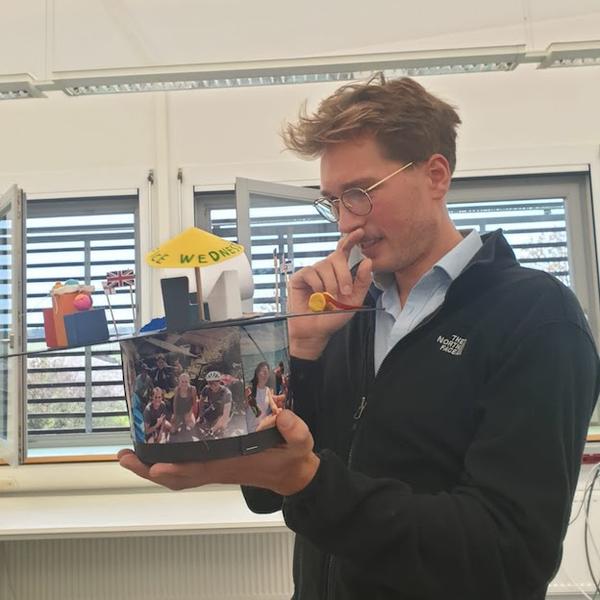
I’m delighted to share that I have been appointed Tenure-Track Assistant Professor in Systems Developmental Medicine at the University of Basel 🎉. Starting on 1 January 2027, I’ll hold a joint appointment between the Department of Biomedicine (DBM) and the Basel Research Centre for Child Health (BRCCH). There are announcements from the BRCCH, the Department of Biomedicine, and the University of Basel.
What the lab will work on 🔬#
Development doesn’t stop at birth. Organs keep maturing through infancy and childhood, and that maturation is a period when a lot can go right and a lot can go wrong — yet we have far better molecular maps of the embryo than of the growing child.
The lab will build computational methods to close that gap. Concretely, we want to integrate single-cell, spatial, and temporal molecular data into models of how human tissues mature over time, and use them to ask two kinds of question. First, the cell-biological one: how does an individual cell commit to a fate inside a tissue that is itself still growing and reorganising around it? Second, the clinical one: what does normal look like at a given age, and how early can we detect a departure from it?
The longer-term aim is to give pediatricians something they currently don’t have — age-specific molecular references and computational tools that can support clinical decisions, help identify children at risk of developing disease, and inform when treatment is likely to work best. Basel is an unusually good place to try this: the BRCCH connects the University of Basel, ETH Zurich’s Department of Biosystems Science and Engineering — which sits in Basel itself — the University Children’s Hospital Basel, the Swiss TPH, and Fondation Botnar, so the distance from a model to a clinical question is short. The wider ecosystem is just as unusual: the Friedrich Miescher Institute is across town, the Institute of Molecular and Clinical Ophthalmology Basel runs human retina work from molecules through to the clinic, and Roche’s Institute of Human Biology has made organoids and human model systems its core business. Not many cities concentrate that much developmental and computational biology in one place.
Methodologically, this builds on what I’ve been doing — probabilistic modeling, optimal transport, representation learning — but points it somewhere considerably more ambitious. Generative models are getting good enough to simulate tissue rather than merely summarise it, and the data are moving just as fast: subcellular-resolution spatial transcriptomics, high-content imaging, and multimodal readouts that put molecules, morphology, and time in the same frame. I want the lab to work at exactly that intersection — generative models that learn from imaging and omics jointly, that respect the fact that development is a process, and that we can interrogate rather than merely sample from. And unlike most of my previous work, there will be a clinic on the other side of the question.
Thank you 🙏#
Nothing here happened alone. Thank you to Barbara Treutlein and Dana Pe’er, who have shaped how I think about development and about data during my postdoc, and to Fabian Theis, in whose group I learned how to build methods that other people can actually use. Thank you also to ETH D-BSSE, MSKCC, and EMBO for supporting the work that led here — and to the search committees at the DBM and the BRCCH for the trust.
Thank you as well to my collaborators, past and present — experimentalists, clinicians, and method developers who were willing to explain their systems to someone arriving from mathematics, and who asked the questions that made the methods worth building. Very little of this work would exist without them.
And thank you to everyone who has used, broken, and improved CellRank and moscot over the years. A tool only becomes useful once other people push it somewhere you didn’t anticipate.
Come build it with me 🚀#
I am recruiting PhD students and postdocs now, for positions starting in 2027, and I supervise Master’s theses. If you like thinking carefully about models and care about what they say biologically, have a look at the Join the Lab page for what the positions involve and how to apply.